'An Event of Extreme Imagination and Desire': In Conversation with Kelly Wu
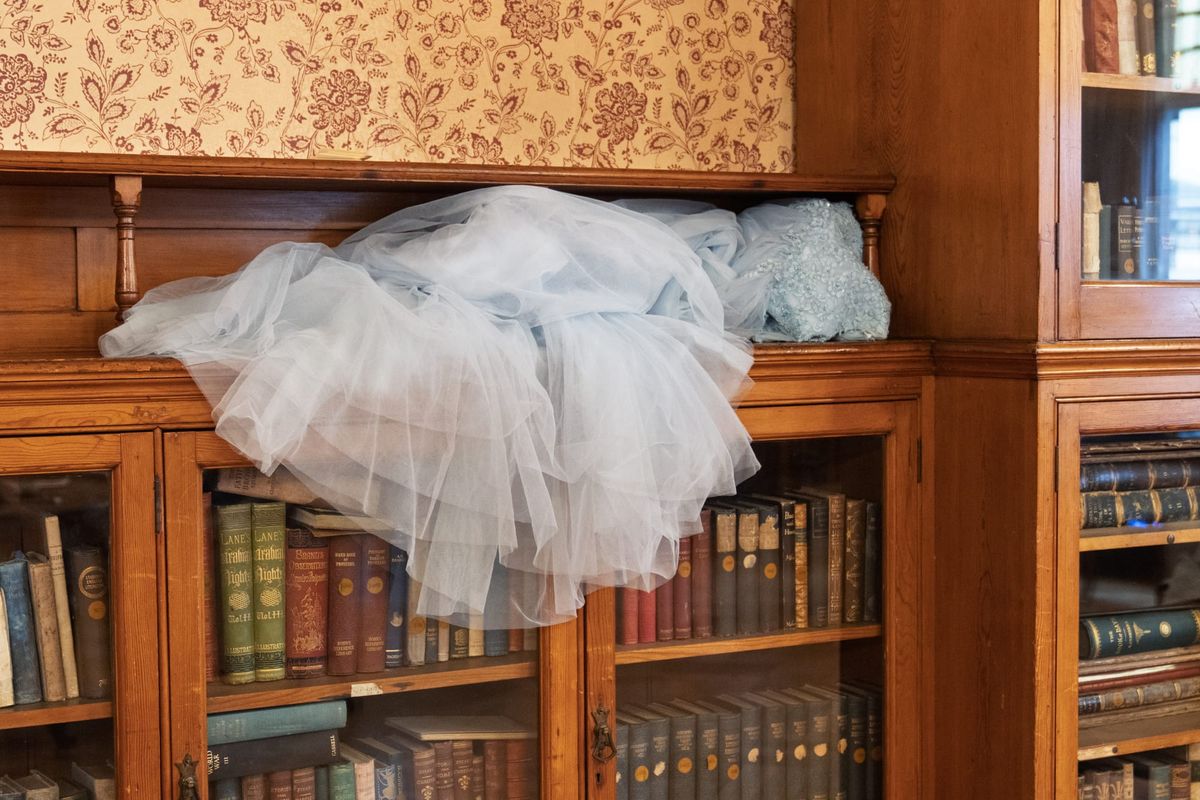
Last weekend, Kelly Wu’s 'Waiting for It to Be Right' featured in Sonder, a site-responsive group exhibition within the Grade II listed Queen Alexandra’s House in Kensington. I spoke to Kelly about the inspiration behind their piece, prom culture, archival residue, and the ghostly afterlives carried within objects.
TOMMY: Can you tell me about the origins of the prom dress itself? Is it archival, found, or constructed/reconstructed? And what drew you to the prom dress as an object to work with artistically?
KELLY: This work is my original prom dress from my secondary school prom in 2018. I have no memory however of where I got it from. All I remember was that I got it online, and that I put all the wrong measurements in the form. Very tight in the chest and armpits all night long, with too-big shoes … It has been completely unaltered since then, except for by the moths and mould which reside in my parents’ flat.
Last year I started thinking about the prom event as a moment of extreme potential energy - the stored energy which an object or system possesses due to its position, arrangement, or state. Prom is one of those sensationalised, long-awaited defining moments, as in television and film, aligned with the drama of debutante balls, coming out, and that sort of culture. Young people step out into the world from a tall height, step over the cliff’s edge, and everything changes from
that point of energy transfer. Historically and still now, it is an especially significant moment for young women.
The work first surfaced for Annie Versailles, a duo show I did in April at MEZZANINE, with my partner Jo. We had it both as a sculptural element, hanging over the ceiling railings, and also incorporated into the finissage performance as a worn item of clothing. The sculptural version of the dress, Waiting for It to Be Right, is currently being shown again in the drawing room at Queen Alexandra’s house.
T: Prom culture may be thought to hover somewhere between adolescent fantasy, performance, and social ritual/rite of passage. What interests you about it?
K: When you are a young person, you are splintered into many parts, and asked to choose just one or two of those parts to grow into your ‘tree.’ It is such a potent, intense time, full of laughing, learning, arguing, and fearing, and you can of course choose to do whatever you like for the most part. But I have found that decisions that I made, that I was asked to make during that time were always made very heavy-handedly. They indelibly change some aspect of your adult life. Very rarely at my present age of 24 am I ever asked to choose my career path, partner, city, university, and job all at the same time. I don’t remember ever sleeping back then.
Prom then comes in from the side door. As British people, we have absorbed the prom, in this exact form, from America, as we have absorbed lots of other horrible things in recent years. I find the Americana of it all very interesting, as well as the marked gender roles and subversions that come about. The potential energy of a moment comes back into the conversation, as prom is seen as one of those last moments of youth, a height of sex or power (queen), or intellect or friendship. I suppose the fantastical element of it is what lies in the future, in the potential. It is
an event of extreme imagination and desire.
T: There’s something quite ghostly about the piece, and mainly how it appears almost abandoned in the installation. Was this intentional?
K: Human forms without human life will always have that ghostly feeling, and I suppose this is accurate, for the dress did used to contain my adolescent body. So I suppose it is the ghost of her, or myself, that resides inside. Still, the work is not about death really, or death of youth, or one of those readings which normally accompany a limp, figurative work. I abandoned it once, in 2018, but have now picked it back up again, reinstated it, loved on it again. I have asked people to look
at it and touch it and communicate with it. I think that the dress itself is not a sentient being, but rather a residue, left over from the activity of sentient beings.
T: The piece is being exhibited inside Queen Alexandra’s House, a building that was originally created to house women students in the nineteenth century. Did that history inform or affect how you approached the installation?
K: I knew that I wanted to use the prom dress for this exhibition because it fits so perfectly into that history. I believe that Sonder is the second-ever exhibition to take place in the drawing room in the last 140 years. The building was originally erected in 1884 to accommodate women students of the Royal Colleges, and is still active today, for women students studying at universities in Kensington. The accommodation itself is a future - an end point of transfer for that potential energy.
T: The exhibition frames the house as a “lived, evolving archive.” What does archive mean to you in your own practice?
K: I was raised an archiver, a product and victim of my mother’s hoarding. This caused me to find both significance and insignificance in material things for the rest of my life, assigning value to the most mundane things and throwing away things that other people would deem as valuable.
Now, as an adult, I do not collect as fiercely. What I think I collect now more than anything else is memories. I store them all inside, regurgitating them back out for various works and writings.
Alongside my art practice I also work in libraries (public and academic), which have been a crucial point of support for my practice both in the way of resources and in learning about collections, archives, and literature. Archiving will always have an important role in my work as a starting point for work, and as an important emotional practice.
T: What kinds of responses are you hoping to evoke (and/or what kinds of discourses are you encouraging) from viewers of the piece?
K: Proms, balls, and these sorts of events have trickled down from the traditions of the elites, and I hoped that the work could create a sense of discomfort in the viewer, as well as being quite beautiful against the surroundings and the women’s history. A crumpled, tense, dress (person?) squeezed into the very corner of a room to which they do not belong
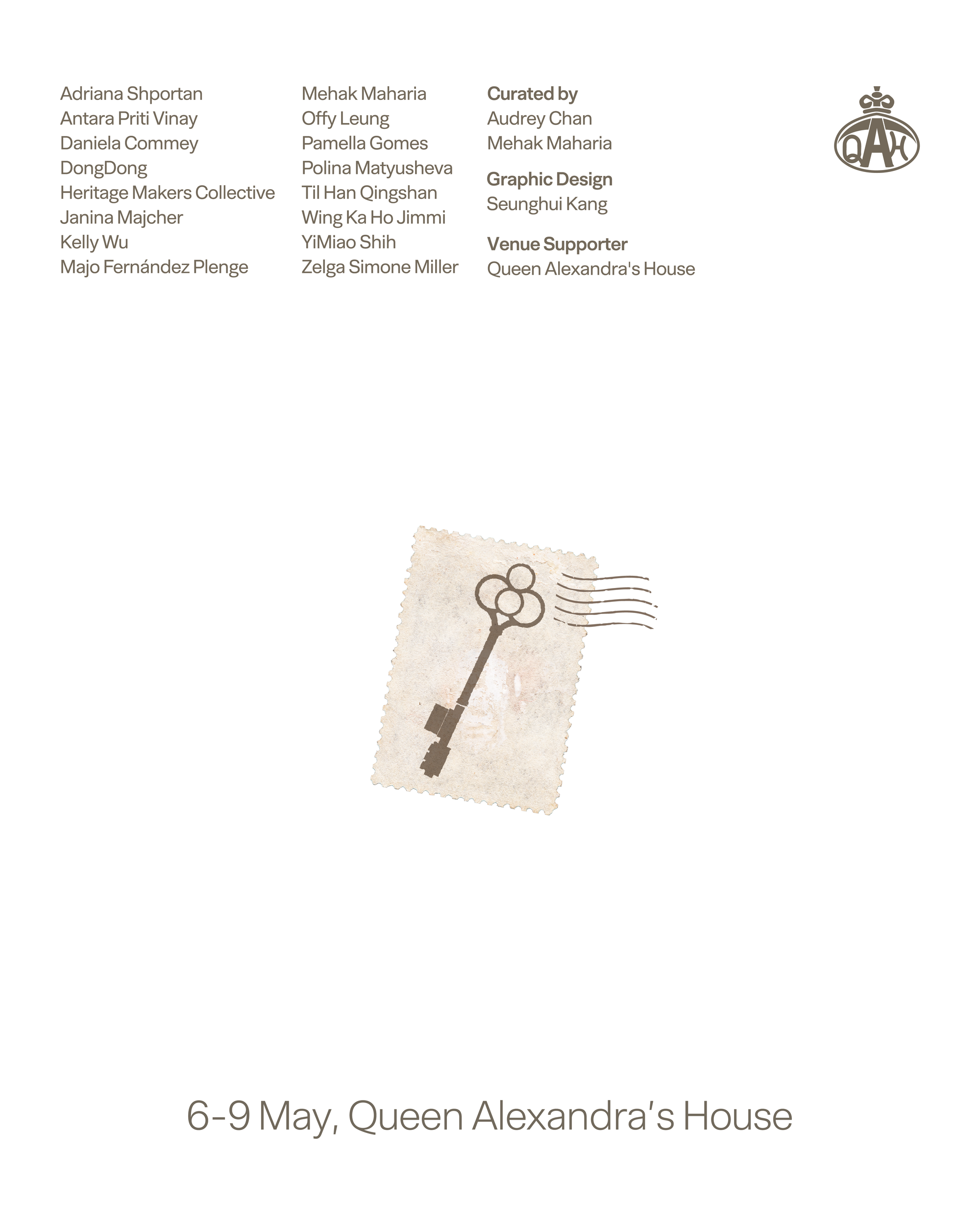
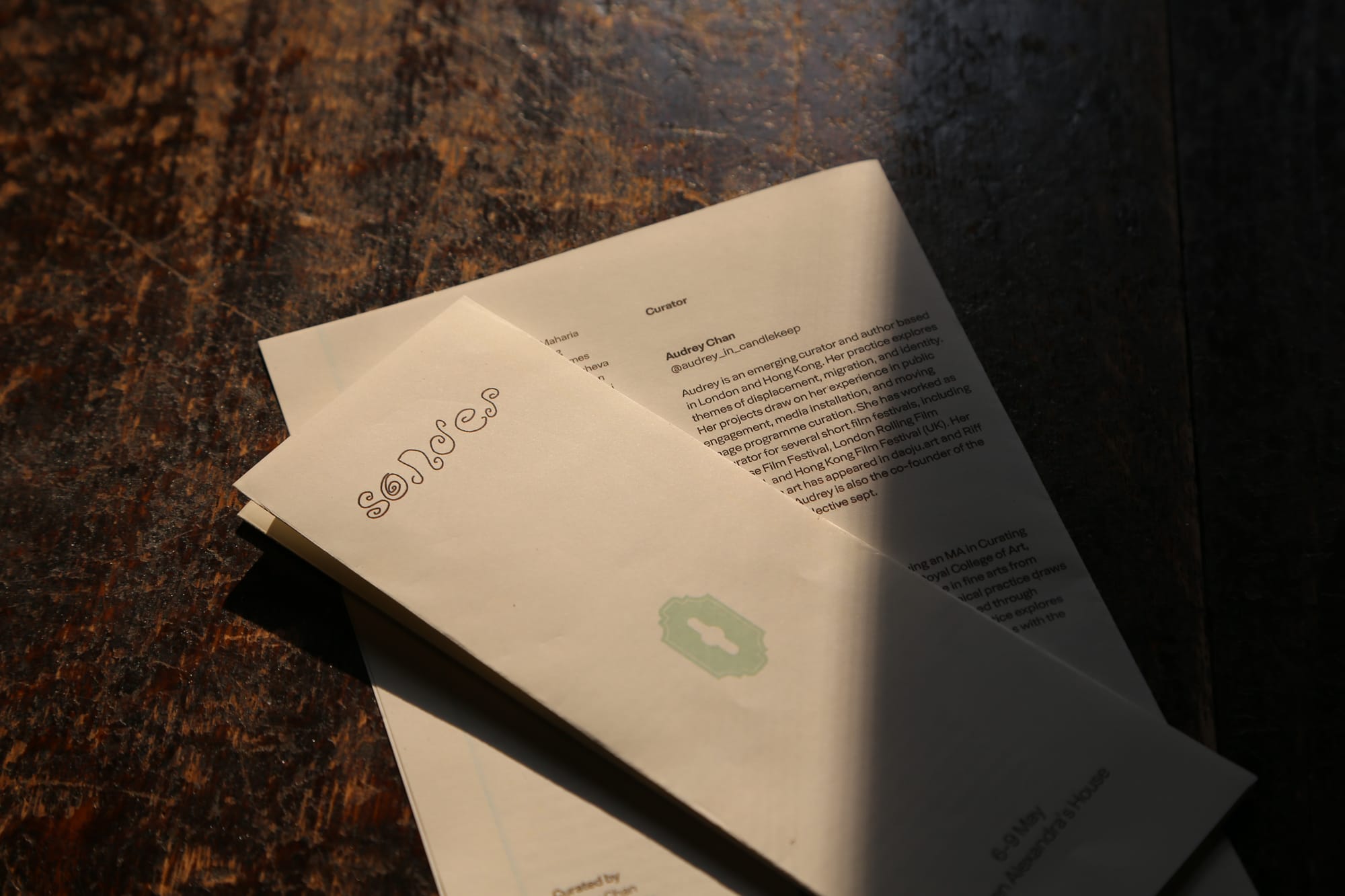
Curatorial Statement
Sonder is a site-responsive group exhibition situated within the Grade II listed historic building, Queen Alexandra’s House. As a female accommodation building for nearly two centuries, the House is converted to a heritage that is lived rather than inherited.
In the Drawing Room, the life of Queen Alexandra is reframed as a series of archival fragments, preserving the quiet pleasure of reading and the shared intimacies. Two centuries later, these gestures of daily life are revisited and reinterpreted by the artists through the trajectories of migration, the quiet anxieties and constraints of everyday life, fleeting moments of beauty, obscured identities shaped by war, and the traces of ancestry and lineage that carry the marks of time. Contemporary works distill lived experience into specimens placed within cabinets, where they accumulate the subtle imprints of time through touch, temperature, and humidity, as a new series of collections in the Drawing Room, starting another century of personal and communal stories.
Within a space conceived as a “home away from home”, the works project deeply personal but also communal living experiences. Bringing together works in painting, sculpture, video, sound, text, and installation, Sonder celebrates the richness of coexistence, foregrounding the emotional dimensions of inhabitation. By considering how rooms, corridors, and thresholds carry layered stories and voices, we invite the audience to move between different temporalities of dwelling. It explores belonging and openness alongside familiarity and discovery, offering a space where personal histories intersect and unfold.
(Curatorial Statement written by Audrey Chan / @audrey_in_candlekeep)
Kelly Wu is a queer Chinese‑British artist whose practice spans sculpture, installation, exhibition-making and performance practice. Rooted in an expansive engagement with found, stolen and gifted objects, they collect personal and cultural materials, and edit them into minimal forms which contend with significant political-personal histories. Their work is materially anchored in the practice of archiving and editing life itself, opening up spaces for intimacy, obfuscation and layered narratives, through objects and their complex backstories. Kelly’s sustained interrogation of race, gender and class is essential to their research, but can often be concealed within the ungenerosity of the works. Running parallel to their material practice, they engage in diary‑writing and a ‘life‑art’ performance practice.